Everest Base Camp Trek with Helicopter Return to Lukla- 12 Days

Trip Facts

  • Duration 12 Days
  • Difficulty Level Moderate
  • Destination Nepal
  • Transportation Private Vehicle, Domestic Flights and Shared Helicopter Ride
  • Activity Approximately 5-6 hours Trekking/Hiking, & Heli Ride
  • Best Season Febrary-May and September - December
  • Group Size Min. 1 & Max. 14 People
  • Trip Start/End Kathmandu
  • Max Altitude 5545m/11283ft at Kalapatthar

12-Day Everest Base Camp Trek with Helicopter Return

The 12-Day Everest Base Camp Trek with Helicopter Return to Lukla is an excellent choice for travelers who want to complete the classic journey within a two-week holiday.

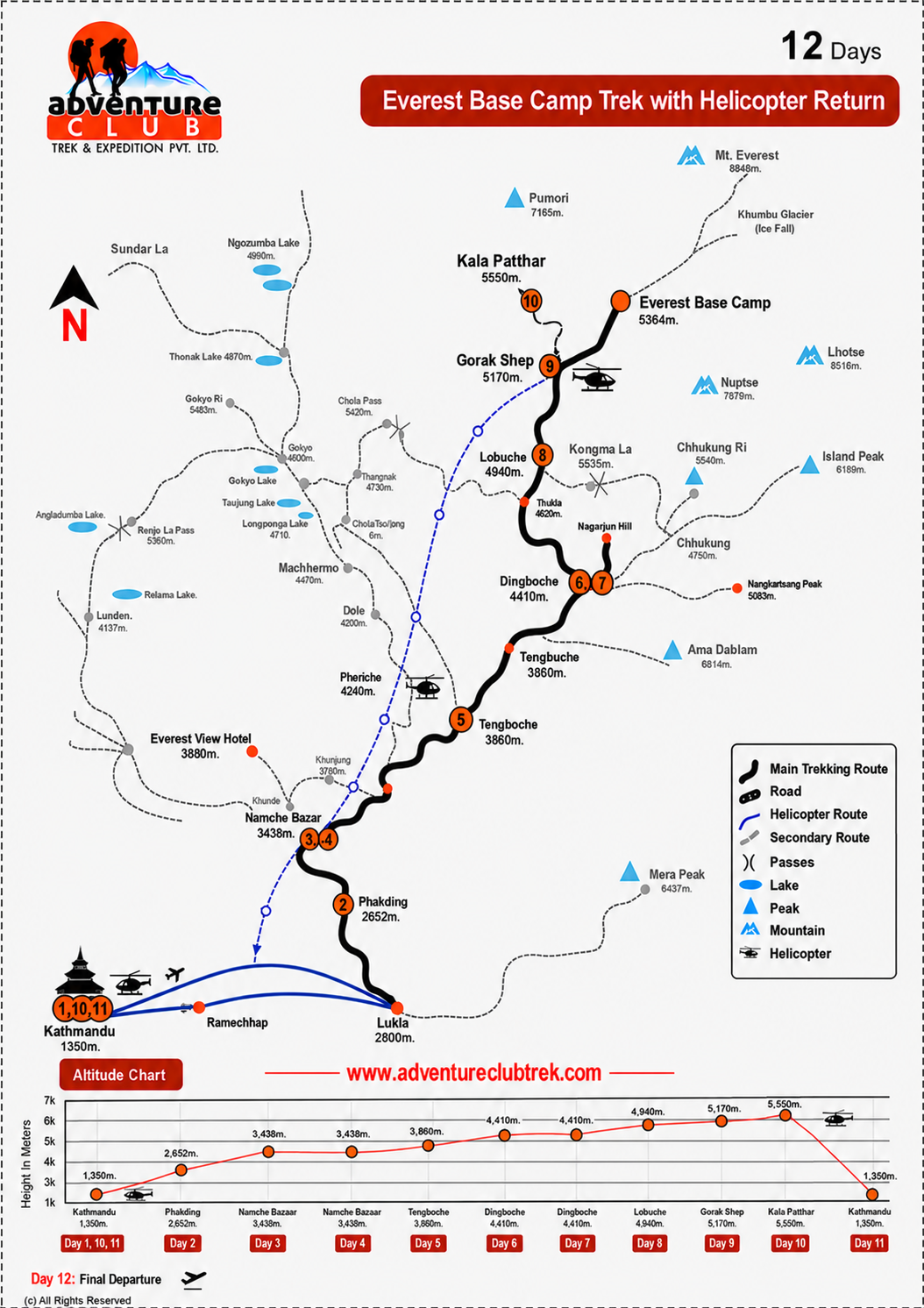
You will trek all the way to Everest Base Camp (5,364 m / 17,598 ft) andKala Patthar (5,545 m / 18,192 ft) on foot before returning by a shared helicopter flight from Gorak Shep to Lukla. This time-saving itinerary lets you complete the classicEverest Base Camp trek while making the most of your time in Nepal.

Your adventure begins with a scenic flight to Lukla, the gateway to the Everest region. The trail follows the Dudh Koshi River through pine forests, across suspension bridges, and past traditional Sherpa settlements before entering Sagarmatha National Park, a UNESCO World Heritage Site.

As you climb deeper into the Khumbu Valley, an acclimatization day in Namche Bazaar gives your body time to adjust safely to the increasing altitude while offering panoramic views of Everest, Lhotse, and Ama Dablam. The trail then continues to Tengboche Monastery, the spiritual heart of the Everest region, before climbing above the tree line into a rugged alpine landscape.

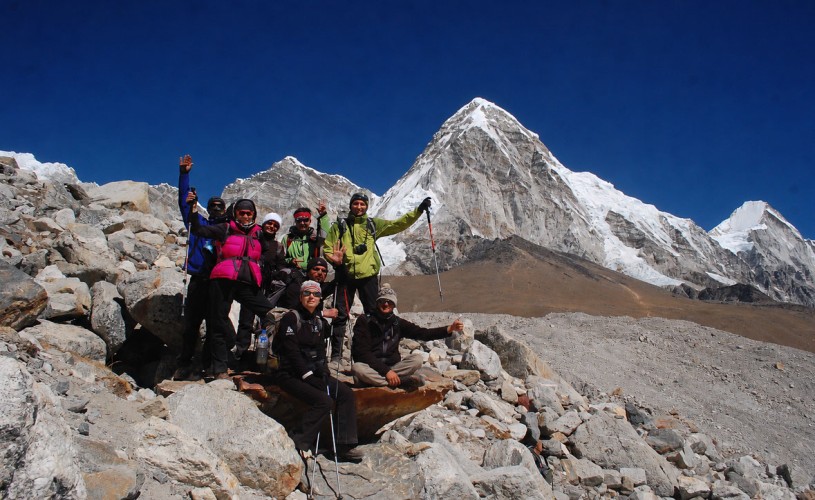
Passing through Dingboche and Lobuche, you will trek beneath towering Himalayan peaks before reaching Everest Base Camp beside the Khumbu Glacier. The following morning, an early hike to Kala Patthar rewards you with some of the finest close-up sunrise views of Mount Everest and the surrounding peaks.

After watching the sunrise from Kala Patthar, many trekkers enjoy a rewarding sense of achievement but are less enthusiastic about spending another three days walking back along the same trail.

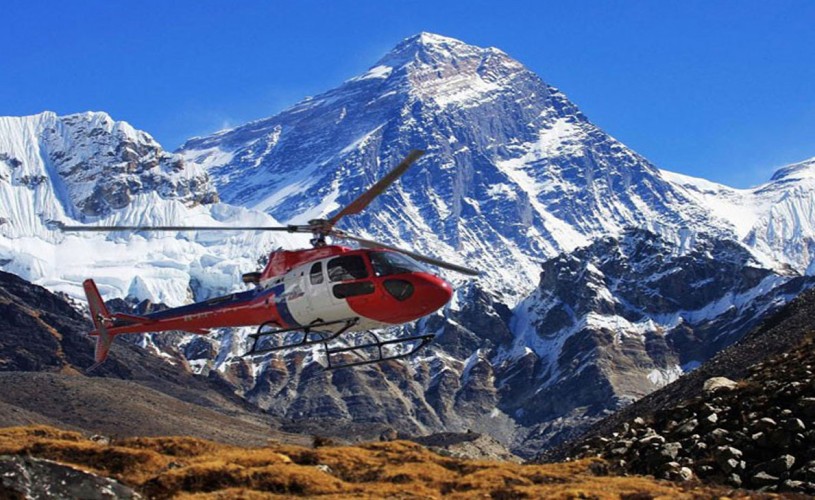
Instead of retracing the same route, you'll board a shared helicopter flight from Gorak Shep to Lukla. The flight provides a completely different perspective of the Khumbu Valley, with sweeping views of glaciers, mountain ridges, and remote Sherpa villages before you connect with your scheduled domestic flight back to Kathmandu.

Mountain weather in the Everest region can change quickly, and passenger safety always comes first. Helicopter departures depend on suitable weather and clear visibility. If weather conditions delay your flight from Gorak Shep, our experienced local team will arrange the best available alternative and adjust your itinerary accordingly.

This itinerary is particularly popular among trekkers with limited holiday time or who simply prefer to avoid the long descent while still completing the full Everest Base Camp experience.

Beyond the mountain scenery, this trek is also about experiencing the Everest regionat a comfortable pace. Each day brings something different, from welcoming Sherpa villages and centuries-old monasteries to peaceful forests, high alpine valleys, and unforgettable Himalayan views.

With a carefully planned itinerary, proper acclimatization, and the convenience of a helicopter return, you can focus on enjoying the journey while our experienced local team takes care of the logistics. It is a rewarding way to experience one of Nepal's most iconic trekking routes, even if you have only two weeks to travel.

Itinerary

+ Expand All- Collapse All

Upon your arrival at Tribhuvan International Airport (KTM), a representative from Adventure Club Trek will warmly welcome you and transfer you to your hotel in our private vehicle after you complete the arrival formalities (visa, customs, and so on). After some time to relax, you'll meet your trekking leader for a short trek briefing, followed by a welcome dinner. Overnight in Kathmandu.

  • AccommodationHotel
  • MealsWelcome Dinner
  • Max. Altitude1,400 m / 4,593 ft

Today, we take an early morning flight to Lukla, the starting point of our Everest adventure. The short mountain flight offers beautiful views of hills, valleys, and snow-capped peaks on clear days. After landing in Lukla, we meet our trekking crew, make a few final preparations, and begin our journey into the Khumbu region.

From Lukla, we follow a gentle trail through small Sherpa villages and farmland alongside the Dudh Koshi River to Phakding. Along the way, you may catch a glimpse of Khumbila, a sacred mountain that the Sherpa people deeply respect and have never climbed.

The trail passes through Cheplung and several small settlements before reaching the peaceful village of Phakding. Today's walk is short and easy, giving you time to settle into the trek, enjoy the scenery, and begin adjusting to the mountain environment before the trail climbs higher tomorrow. Overnight in Phakding. 

Please Read the Flight Information: During the busy trekking seasons, most flights to Lukla operate from Ramechhap Airport instead of Kathmandu. Ramechhap is about a 4 to 5-hour drive from Kathmandu, so we usually leave very early in the morning, often around 2:00 AM, to catch the flight. At the end of the trek, the drive back from Ramechhap to Kathmandu also takes about 4 to 5 hours, depending on road and traffic conditions.

  • AccommodationTeahouse
  • MealsBreakfast, Lunch and Dinner
  • Max. Altitude2,610 m / 8,563 ft

After breakfast in Phakding, we continue our trek to Namche Bazaar, the main Sherpa town in the Everest region. The trail follows the Dudh Koshi River through pine forests and small villages, crossing several suspension bridges along the way. We pass through Monjo and enter Sagarmatha National Park, where our permits are checked before continuing to Jorsale for lunch. From Jorsale, the trail follows the river before crossing the famous Hillary Suspension Bridge. The final climb to Namche is the most challenging part of the day, but the effort is well worth it. On a clear day, you may catch your first view of Mount Everest as you make your way uphill. By late afternoon, we arrive in the lively mountain town of Namche Bazaar, where we spend the next two nights. Overnight in Namche Bazaar. 

  • AccommodationTeahouse
  • MealsBreakfast, Lunch and Dinner
  • Max. Altitude3,440 m / 11,286 ft

Today is an important acclimatization day to help your body adjust to the higher altitude before we continue deeper into the Everest region. Rather than resting all day, we take a short hike to a higher elevation and return to Namche Bazaar for the night.

A popular option is a hike to the Everest View Hotel, which offers beautiful views of Everest, Lhotse, Nuptse, Ama Dablam, and other Himalayan peaks on a clear day. You can also visit the Sherpa Culture Museum or spend some time exploring Namche Bazaar, the lively heart of the Khumbu region. The town has an ATM, cafés, bakeries, gear shops, and a colorful local market that comes alive on Saturdays. After our hike and some time exploring, we return to our lodge in Namche Bazaar.

  • AccommodationTeahouse
  • MealsBreakfast, Lunch and Dinner
  • Max. Altitude3,440 m / 11,286 ft

After breakfast, we leave Namche Bazaar and follow a scenic trail with beautiful views of Everest, Lhotse, Nuptse, Ama Dablam, Thamserku, and Kongde on clear days. The trail gradually descends to the Dudh Koshi River before climbing through pine and rhododendron forests to Tengboche. Tengboche is one of the most beautiful villages in the Everest region and is home to the famous Tengboche Monastery, the largest monastery in the Khumbu region. After reaching the village, we can visit the monastery and enjoy stunning mountain views, especially of Ama Dablam, which rises prominently above the valley. Overnight in Tengboche.

  • AccommodationTeahouse
  • MealsBreakfast, Lunch and Dinner
  • Max. Altitude3,860 m / 12,664 ft

After leaving Tengboche, we descend through forests of pine, rhododendron, and juniper before crossing the Imja Khola. The trail then climbs gradually to Pangboche, one of the oldest Sherpa villages in the region. Along the way, we enjoy excellent views of Everest, Lhotse, and the striking peak of Ama Dablam.

Beyond Pangboche, we pass through the small villages of Shomare and Orsho as the landscape begins to change above the tree line. Surrounded by rugged mountains and the wide Imja Valley, we continue to Dingboche, a peaceful village known for its stone-walled fields and beautiful mountain scenery. Overnight in Dingboche.

  • AccommodationTeahouse
  • MealsBreakfast, Lunch and Dinner
  • Max. Altitude4,410 m / 14,469 ft

Today is our second acclimatization day, giving your body time to adjust to the higher altitude before we continue towards Everest Base Camp. Dingboche is a beautiful mountain village surrounded by stone-walled fields, with impressive views of Ama Dablam, Lhotse, and other Himalayan peaks. To help with acclimatization, we take a short hike to Nagarjun Hill or towards Chhukung Valley. Both hikes offer beautiful views of Makalu, Lhotse, Cholatse, Taboche, and the surrounding mountains. After the hike, we return to Dingboche to rest and prepare for the higher elevations ahead. Overnight in Dingboche.

  • AccommodationTeahouse
  • MealsBreakfast, Lunch and Dinner
  • Max. Altitude4,410 m / 14,469 ft

Today, we continue deeper into the high Himalayas as the landscape becomes more rugged and the altitude more noticeable. The trail climbs gradually to Dughla (Thukla), where a steep ascent leads us to the memorial site dedicated to climbers and Sherpas who lost their lives on Everest and other nearby peaks.

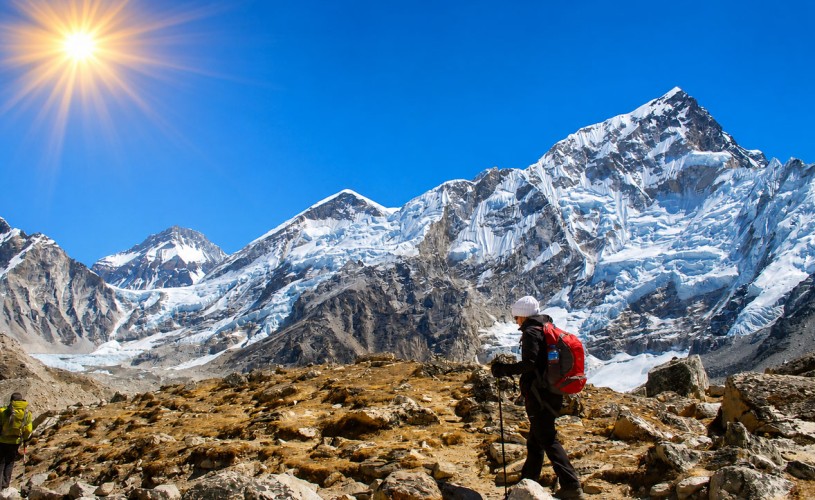
From here, we follow the edge of the Khumbu Glacier, surrounded by dramatic mountain scenery. Along the way, we enjoy views of Pumori, Nuptse, Lingtren, Khumbutse, and other surrounding peaks. The trail then becomes more gradual as we make our way to the small settlement of Lobuche, where we spend the night beneath some of the world's highest mountains. Overnight in Lobuche.

  • AccommodationTeahouse
  • MealsBreakfast, Lunch and Dinner
  • Max. Altitude4,910 m / 16,109 ft

Today is one of the highlights of the trek as we make our way to Everest Base Camp. After a gradual walk from Lobuche, we reach Gorak Shep, the last settlement on the Everest Base Camp trail, where we stop for lunch and leave our heavier bags at the lodge. We then continue along a rugged trail over rocky moraine beside the Khumbu Glacier. At this altitude, the pace is slow and steady as the thinner air makes every step more challenging.

Reaching Everest Base Camp is a special moment and the reward for all the effort of the past few days. During the spring climbing season, you may see colorful expedition tents spread across the glacier as climbers prepare for their summit attempts. Surrounded by towering peaks and the dramatic Khumbu Icefall, we take time to enjoy this achievement before returning to Gorak Shep for the night. Overnight in Gorak Shep.

  • AccommodationTeahouse
  • MealsBreakfast, Lunch and Dinner
  • Max. Altitude5,364 m / 17,598 ft

Today, we hike to Kala Patthar (5,545 m / 18,192 ft), the highest point of this itinerary and one of the best viewpoints in the Everest region. We begin before dawn to reach the summit in time for sunrise, where you'll enjoy spectacular views of Mount Everest, Lhotse, Nuptse, Pumori, and the surrounding Himalayan peaks. After spending some time at the summit, we descend to Gorak Shep for breakfast.

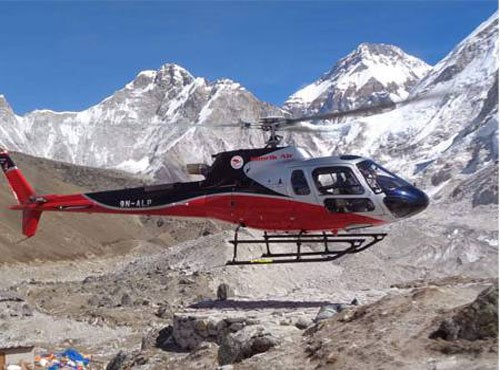
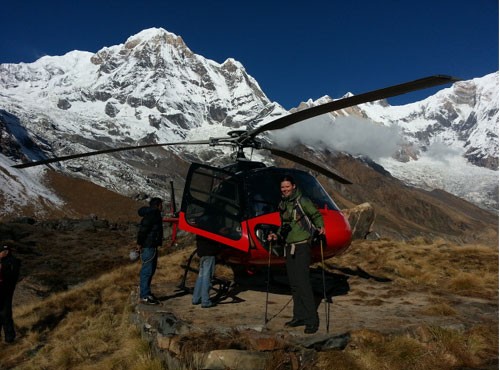
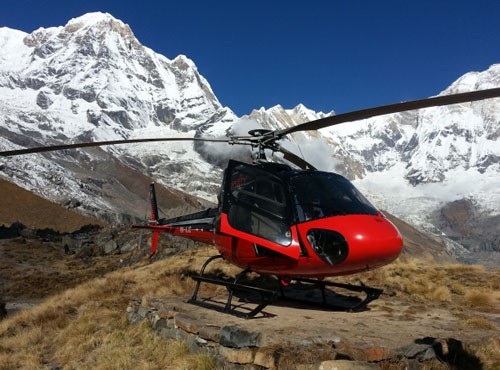
After breakfast, we board a shared helicopter flight to Lukla. The flight offers spectacular aerial views of the Khumbu Valley and the Himalayan landscape you've explored on foot.

Helicopter Flight Information: This package includes a shared helicopter flight, not a private charter. Due to high-altitude operating limitations, helicopters from Gorak Shep often operate as shuttle flights. Depending on passenger numbers, weather, and operating conditions, the helicopter may first fly some passengers to a lower-altitude location, usually Pheriche, before continuing to Lukla. The flight from Gorak Shep to Lukla typically takes around 15–20 minutes, depending on routing and operating conditions. If you prefer a private helicopter charter, please contact us for available options and current pricing.

  • AccommodationTeahouse
  • MealsBreakfast, Lunch and Dinner
  • Max. Altitude5,555 m / 18,225 ft

After breakfast, we head to Tenzing-Hillary Airport in Lukla for our return flight. The scenic 30–40-minute mountain flight offers a final glimpse of the Himalayan landscape, with views of peaks such as Kongde, Kusum Kanguru, Thamserku, and other snow-capped mountains on clear days.

Upon arrival in Kathmandu, our guide will transfer you to your hotel. The rest of the day is free to rest, relax, explore Kathmandu, or simply enjoy some well-deserved time after completing your Everest Base Camp adventure.

In the evening, we celebrate your achievement with a farewell dinner with your trekking team and fellow trekkers, sharing stories and reflecting on the unforgettable journey through the Khumbu region.

Please Read the Flight Information: During peak trekking seasons, Lukla flights may operate via Ramechhap (Manthali) Airport rather than Tribhuvan International Airport in Kathmandu. If your return flight is routed to Ramechhap, our team will arrange the road transfer from Ramechhap to Kathmandu. The journey usually takes approximately 4–5 hours, depending on road and traffic conditions. Flight operations are subject to weather and airport conditions, so the exact routing may change

  • AccommodationHotel
  • MealsBreakfast and Faewell Dinner
  • Max. Altitude1,400 m / 4,593 ft

Our Everest Base Camp Trek with Helicopter Return 12-day trip ends here. A representative from the Adventure Club Trek will accompany you and see you off at Tribhuvan International Airport a few hours before the scheduled flight to your home.

Note: If you still have a few days after the trekking schedule, you might be interested in experiencing other adventurous activities like jungle safari, rafting, and bungee jumping. You may contact the Adventure Club Trek for the arrangement.

  •  
  • MealsBreakfast

Cost Details

Price Includes

Accommodation

  • 2 nights' twin-sharing accommodation in a 3-star hotel in Kathmandu with breakfast.
  • 9 nights' twin-sharing guesthouse accommodation during the trek.
  • Attached bathroom facilities in Lukla, Phakding, and Namche (subject to availability).

Meals

  • 9 breakfasts, 8 lunches, and 8 dinners during the trek.
  • One cup of tea or coffee with each meal.
  • Seasonal fruits during the trek.
  • Welcome and farewell dinner in Kathmandu.
  • Water purification tablets.

Transportation & Flights

  • Private airport transfers (international and domestic).
  • One-way domestic flights from Kathmandu to Lukla.
  • Shared helicopter flight from Gorak Shep to Kathmandu via Lukla.
  • Private vehicle transfers between Kathmandu and Manthali.

Guide & Support Staff

  • Experienced, government-licensed, English-speaking trekking guide with first-aid training.
  • One porter for every two trekkers.
  • All staff salaries, meals, accommodation, insurance, equipment, and medical expenses.

Permits & Entry Fees

  • Sagarmatha National Park Entry Permit.
  • Khumbu Pasang Lhamu Rural Municipality Permit.

Trekking Gear & Trip Benefits

  • Adventure Club duffel bag.
  • Adventure Club Trek T-shirt.
  • Everest Base Camp trail map.
  • Sleeping bag and down jacket (returned after the trek).
  • Comprehensive first-aid kit with a pulse oximeter for daily oxygen level monitoring.
  • Everest Base Camp Trek with Helicopter Return Trip Completion Certificate.

Administrative Costs

  • All applicable government and local taxes are included.

Price Excludes

  • Nepal entry visas. Visa fee options: USD 30 for a 15-day visa, USD 50 for a 30-day visa, USD 125 for a 90-day visa
  • Lunch and evening meals in Kathmandu.
  • International airfares/flights (fares and flights can be arranged upon request).
  • Hot showers, extra meals, Wi-Fi, battery charging during the trek
  • Extra nights in Kathmandu due to early arrival, late departure, or returning earlier than planned.
  • Personal expenses (alcoholic drinks, bottled water, cold drinks).
  • Travel Insurance. 
  • Personal trekking equipment.
  • Tips for guides, porters, and drivers (tipping is expected but not mandatory).

Useful Info

Lukla Flight Information & Delays

Flights to Lukla are closely influenced by both seasonal air traffic and mountain weather, so your flight arrangements can differ depending on when you travel.

During the peak trekking months of March, April, May, September, October, and November, Lukla flights generally operate from Ramechhap (Manthali) Airport rather than Kathmandu. Ramechhap is around 4–5 hours by road from Kathmandu, although the journey can take longer depending on traffic and road conditions. During the quieter months, flights normally operate from Kathmandu.

The exact departure airport is determined by the airlines and current flight operations. Weather can also change quickly in the Everest region, and delays or cancellations are possible even when conditions are clear in Kathmandu.

For this reason, we strongly recommend keeping 1–2 extra days in your Nepal itinerary, particularly before your international flight home. This gives you a practical buffer if your Lukla flight is delayed or cancelled and helps avoid the risk of missing your onward flight. If a flight disruption occurs, our team will monitor the situation and help arrange the most practical available alternative.

Please reread. 

  • Baggage Allowance: Lukla flights allow 10 kg of checked baggage plus 5 kg of hand carry per passenger per flight. Excess baggage may incur additional charges and is subject to the airline's weight restrictions.
  • Helicopter Options: If your regular flight is cancelled due to weather and you choose to travel by helicopter, the fare is USD 550 per person, or USD 3,200 for a private helicopter charter.
  • Flight Ticket Refund: When a Lukla flight is cancelled due to weather, the airline ticket is normally fully refunded. We will apply the refunded flight amount toward the helicopter cost, so you only pay the remaining difference per passenger.

Weather & Best Time to Trek

The best seasons for the Everest Base Camp trek are spring and autumn, particularly March to May and late September to November. These months generally offer more stable weather, clearer mountain views, and good trail conditions. October and November are especially popular, so teahouses and flights can be busy.

Winter (December to February) brings colder temperatures and freezing conditions at higher elevations, but clear skies can provide excellent mountain views. Some lodges operate throughout the season, although facilities are more limited.

The monsoon months of June to August bring rain to lower sections and can affect flights to Lukla. The Everest region receives less rain than many parts of Nepal, but cloud and wet trails can still make travel less predictable.

Mountain weather can change quickly in any season, so flexibility remains important.

What is the accommodation like during the trek?

In Kathmandu, you will stay in a comfortable 3-star hotel. During the trek, we use welcoming local teahouses and guesthouses along the route, giving you a chance to experience the simple, friendly style of accommodation found in the Everest region.

Rooms are normally twin-sharing, with another trekker of the same gender. Private rooms can be requested for an additional fee, although availability becomes limited at higher altitudes, particularly during the busy spring and autumn seasons.

Up to Namche Bazaar, the teahouses we select generally offer rooms with attached bathrooms. Above Namche, accommodation becomes more basic, with shared toilets and washing facilities. Hot showers are available at many lodges, although availability and heating methods, including gas, solar power, or heated water, vary with altitude and lodge.

A hot shower usually costs around USD 3–5, with prices generally increasing as you climb higher. After a long day on the trail, many trekkers find it well worth the extra few dollars.

What is the food like on the Everest Base Camp Trek?

Breakfast, lunch, and dinner are included during the trek. Breakfast is also included at your Kathmandu hotel, while lunch and dinner in Kathmandu are normally arranged separately unless stated in your itinerary. We also host welcome and farewell dinners for our guests.

During the trek, breakfast and dinner are served at the teahouse where you stay, while lunch is usually taken at a teahouse along the trail. Menus offer a surprisingly wide choice, including eggs, toast, porridge, momos, dal bhat, noodles, pasta, soup, fried rice, and chow mein. Dal bhat, made with rice, lentils, and vegetables, is particularly popular because it is filling and provides a good source of energy for long trekking days.

We recommend choosing freshly cooked vegetarian meals at higher elevations. Meat is transported into the mountains from lower areas, and storage conditions can vary, so many experienced trekkers prefer to avoid it above Namche.

Drinking Water on the Everest Base Camp Trek

Drinking water is not included with your meals, but safe drinking-water options are available throughout the trek. You can refill your bottle at teahouses or designated water sources and treat the water before drinking. Water purification tablets, a sterilizing pen, or a reliable water filter are all practical options.

Bottled and boiled water are also available at teahouses, but the price increases as you gain altitude because everything has to be transported into the mountains. Expect to pay roughly USD 1 per litre at lower elevations, with prices reaching around USD 4 or more per litre higher on the trail. Bringing a reusable bottle and treating refill water is usually the more economical and environmentally responsible option.

Electricity, Wi-Fi, and mobile networks in the Everest region

Electricity is available at most teahouses, although charging becomes more limited and expensive as you climb higher. Expect to pay around USD 2–6 to charge a phone, camera, or power bank, depending on the location. We recommend bringing a 20,000 mAh power bank.

Cold temperaturescan drain batteries quickly, so keep your phone, camera batteries, and power bank warm, especially overnight.

Wi-Fi is available at many teahouses, but it becomes slower and less reliable at higher elevations. Ncell and Nepal Telecom (NTC) are the main mobile networks in Nepal. Both work reasonably well around Lukla and Namche, while coverage becomes less reliable higher on the trail.

We recommend buying a local SIM/eSIM in Kathmandu and downloading important maps and documents for offline use before starting the trek.

Equipment and Packing List

Packing the right gear will help you stay comfortable throughout your Langtang Valley Trek. Keep your luggage light and bring only the essentials. If you hire a porter, we recommend packing no more than 10 kg (22 lbs) per person in your duffel bag.

Essential Documents

  • Valid passport
  • Nepal visa (or cash to obtain one on arrival)
  • Travel insurance details
  • A few passport-size photos
  • Cash in Nepalese Rupees for personal expenses

Clothing

  • Lightweight hiking shirts (2 to 3)
  • Hiking trousers (2 pairs)
  • Thermal base layer (top and bottom)
  • Fleece jacket
  • Down jacket
  • Waterproof and windproof jacket
  • Waterproof trekking pants (recommended during spring and autumn, essential in the monsoon)
  • Comfortable underwear and sleepwear

Footwear

  • Comfortable, broken-in hiking boots
  • Lightweight shoes or sandals for the evenings
  • Hiking socks (3 to 4 pairs)

Head & Hands

  • Warm hat
  • Sun hat or cap
  • Sunglasses with UV protection
  • Lightweight gloves
  • Neck gaiter or buff (optional)

Daypack Essentials

  • Reusable water bottle or hydration bladder
  • Water purification tablets or a filter
  • Sunscreen and lip balm
  • Personal medications
  • Camera or mobile phone
  • Power bank
  • Headlamp with spare batteries
  • Trekking poles (optional but recommended)

Toiletries

  • Toothbrush and toothpaste
  • Small quick-dry towel
  • Biodegradable soap
  • Toilet paper or tissues
  • Wet wipes
  • Hand sanitizer

Personal First Aid Kit

  • Personal prescription medications
  • Pain relief tablets
  • Blister plasters
  • Bandages
  • Anti-diarrhea medicine
  • Diamox (consult your doctor before use)

Trekking Gear

  • Daypack (20 to 30 liters)
  • Duffel bag (provided by Adventure Club Trek)
  • Sleeping bag (rated to around -10°C, available to borrow if needed)

Optional Items

  • Book or Kindle
  • Journal and pen
  • Snacks or energy bars
  • Portable charger
  • Earplugs

Altitude Sickness: Symptoms & What We Do

Altitude sickness can affect anyone above 3,000 meters, regardless of age or fitness. Common symptoms include headache, tiredness, dizziness, nausea, loss of appetite, and disturbed sleep. Our itinerary allows time for gradual acclimatization, and our guides keep a close eye on how each trekker is feeling.

If you develop symptoms, we do not encourage you to simply push on. Depending on their severity, our guide may recommend resting at the same altitude or descending. Worsening or severe symptoms require immediate descent and medical attention.

Some trekkers consider acetazolamide (Diamox) for altitude sickness. If you are considering it, speak with your doctor before the trek to determine whether it is suitable for you.

We require all trekkers to have travel insurance that covers high-altitude trekking and emergency helicopter evacuation up to the maximum altitude of their itinerary. Some Everest itineraries reach over 5,500 meters, particularly when Kala Patthar is included.

Visa & Entry Requirements

Most foreign nationals require a tourist visa to enter Nepal. You can obtain a Nepal tourist visa before your trip from a Nepalese embassy or consulate or on arrival at Tribhuvan International Airport (Kathmandu) and selected official land border entry points.

Please note that nationals of Afghanistan, Iraq, Cameroon, Ghana, Somalia, Eswatini (formerly Swaziland), Palestine, Zimbabwe, Nigeria, Ethiopia, and Liberia are not eligible for a visa on arrival. Travelers from these countries must obtain a visa from a Nepalese Embassy or Consulate before traveling to Nepal.

Tourist visas are also available at selected official land border entry points into Nepal.

To obtain a tourist visa, you will need:

  • A passport valid for at least six months from your date of arrival.
  • A recent passport-sized photograph (digital or printed).
  • The applicable visa fee.

Tourist Visa Fees

15 Days (Multiple Entry)USD 30
30 Days (Multiple Entry)USD 50
90 Days (Multiple Entry)USD 125

To save time on arrival, we recommend completing the online visa application before your trip and presenting the confirmation receipt at the immigration counter.

Official Nepal Immigration Links

If you have any questions about your visa or entry requirements, our team will be happy to assist you before your arrival in Nepal.

Our Trekking Guides/Leaders 

Here at Adventure Club, our staff is like family. We only use locals to support their communities and train our staff rigorously to be the best they can be—for you! 

  •  Full first-aid training
  • Guide Training (trekking)
  • English and other common languages (as requested) 
  • Village and Land Conservation 
  • Mountaineering (for specialty expeditions or climbing treks)

All our guides are highly trained in all aspects of trekking, conversation, first-aid, and emergency evacuation. They are all very professional, knowledgeable, and passionate about tourism. They are local guides, and their English is sometimes limited to trek-related topics. They know how to facilitate running a smooth and safe trip while appreciating the beauty of the Himalayan world.

Porter Welfare

Our porters play an important role in making your trek safe and enjoyable. We ask all trekkers to treat them with kindness and respect throughout the journey. To protect their health and well-being, each porter carries luggage for a maximum of two trekkers, with a combined weight limit of 20 kg (44 lbs). We kindly ask you to keep your duffel bag within 10 kg (22 lbs) per person.

At Adventure Club Trek, we provide our porters with fair wages, proper clothing and equipment, meals, and accommodation during the trek. If a porter becomes ill or is injured, we ensure they receive the necessary medical care, including emergency evacuation when required. We also follow the guidelines of the International Porter Protection Group (IPPG) and are committed to providing safe and fair working conditions for our trekking staff.

Travel Insurance

Travel insurance is required for the Everest Base Camp Trek. Before you travel, please make sure your policy covers trekking in Nepal up to 6000 meters (19,404 ft) and includes emergency helicopter evacuation.

We recommend that your insurance policy cover the following:

  • Emergency helicopter evacuation
  • Medical treatment and hospitalization
  • Trip cancellation or interruption
  • Lost, stolen, or delayed baggage
  • Personal accident and liability

Please carry a printed or digital copy of your insurance policy, including your policy number and emergency contact details, during the trek.

In the event of an emergency, our guides will arrange the necessary rescue and medical assistance. However, the cost of evacuation and medical treatment is the responsibility of your insurance provider or yourself if your policy does not provide adequate coverage.

Recommended Travel Insurance Providers

There are many travel insurance companies that offer coverage for trekking in Nepal. When choosing a policy, make sure it covers high-altitude trekkingemergency helicopter evacuation, and medical expenses.

Some well-known travel insurance providers include:

America


Canada


Europe

Asia & Middle East


Australia

Please note that the availability of these providers may vary by country. Before purchasing a policy, carefully check that it covers trekking in Nepal up to the maximum altitude of your itinerary and includes emergency helicopter evacuation.

Adventure Club Trek is not affiliated with or endorsed by any of the companies listed above. They are provided only as examples of insurers that many travelers have used for trekking holidays. You are welcome to choose any insurance provider that offers the coverage you need.

Group Size & Guide Support

We keep our scheduled trekking groups to a maximum of 14 travelers, allowing our guides to give everyone personal attention throughout the trek.

Our licensed local guides and porters are assigned according to the group size and itinerary. Since everyone walks at a different pace, our guides manage the group so that nobody feels unnecessarily rushed or left behind.

Solo travelers can join a scheduled small-group departure or choose a private trek. We can also arrange customized departures for larger private groups on request.

Tipping

Tipping is not mandatory in Nepal, but it is a thoughtful way to show your appreciation for good service. If you are happy with the support you receive, you may choose to tip your guide, porter, driver, or hotel staff at the end of the trip.

There is no fixed amount, and how much you tip is entirely up to you. Our guides and porters are paid fairly for their work, so tips are never expected. However, they are always appreciated as a gesture of thanks for their hard work and dedication.

Ask a Question

Sign up for our newsletter

Drop Us a Message